
Tutors for children with SEN; How does a tutor support Quality First Teaching?
For children with special educational needs and disabilities (known as SEN or SEND), a one-to-one tutor, with the correct approach to learning and supportive outcomes, can really help this group of learners to thrive. Tutors for children with SEND can take the learner out of their comfort zone by being a supportive and knowledgeable guide.
The SEND Code of Practice is an important government document to empower parents of children with additional learning needs.
On page 25, the Code states:
…”Early years providers, schools and colleges should know precisely where children and young people with SEN are in their learning and development.
They should:
- ensure decisions are informed by the insights of parents and those of children and young people themselves
- have high ambitions and set stretching targets for them
- track their progress towards these goals
- keep under review the additional or different provision that is made for them
- promote positive outcomes in the wider areas of personal and social development, and
- ensure that the approaches used are based on the best possible evidence and are having the required impact on progress” …
(Follow this link for the original source)
Although this document is intended for schools and colleges, the Limitless Learning team of tutors take our role in providing high quality provision for every pupil as a key aspect of our mission. We are guided by the code of practice for every one of our learners, to find ways to overcome the barriers they face in their education.
This blog shows you the approach used in schools and how it links to one-to-one tutoring, working together to create a solution for every child, responding to the way they learn.
Tutoring for Quality First Teaching – how do we approach teaching?
To get started, we need to explore some of the terms used in the teaching profession, so here comes the science bit!
The goal of educators, no matter the age group, educational setting or needs of the children, is to be responsive. Terms such as differentiation are now termed as adaptive teaching to demonstrate a move away from setting children different tasks and having lower expectations based on lower prior attainment. The idea behind this is to create a space to learn where there are no glass ceilings. Notwithstanding this, glass ceilings can be made without intention and awareness. Follow this link to read more about labelling theory. Many of our Limitless Learners come to us thinking that they can’t learn so we work together to change traditional perceptions of ability and potential – helping them to smash through any glass ceilings that are limiting their success.
Traditional approaches to teaching see the children grouped by ability but there is evolution in teaching to see how learners work best and achieve more. The language around ‘ability’ is changing to ‘attainment’ and the way we talk about the progress of our children is important for their self-identity as a learner and as an intelligent person. At Limitless Learning, we hold to a wide reaching definition of intelligence, recognising that there are multiple intelligences and each individual has a unique value that is to be nurtured and cherished.
The approach of all teachers is to provide Quality First Teaching (QFT) to all pupils and this may include:
- Small Step Planning
- Planning for Error
- Assessment for Learning Strategies
- Using concrete manipulatives or representatives (Concrete Manipulative Approach)
- Metacognition strategies
- Modelling
- Explicit teaching of vocabulary
- Examples of ‘What a Good one looks Like- or a WAGOLL!
- Excellent use of Questioning
(Adapted from Third Space Learning- follow the link to find out more about each of the teaching techniques).
In addition to this, the Personalised Learning Practical Guide from the Department of Children, Schools and Families summarises the key characteristics of QFT as:
- Highly focused lesson design with sharp learning objectives
- High demands of pupil involvement and engagement with their learning
- High levels of interaction for all pupils
- Appropriate use of questioning, modelling and explaining on the part of the teacher
- An emphasis on learning through dialogue, with regular opportunities for pupils to talk both individually and in groups
- An expectation that pupils will accept responsibility for their own learning and work independently
- Regular use of encouragement and authentic praise to engage and motivate pupils
(Taken from the Personalised Learning Practical Guide 2008: p12)

One to One tutoring to children with additional learning needs: The Waves of Intervention
Following the implementation of high Quality First Teaching with adaptive teaching strategies, there may be children who require further steps to be taken to support them in achieving their full potential.
These take the form of stages of intervention, or waves.
[https://www.twinkl.co.uk/resource/t-s-3294-waves-of-intervention-display-poster]
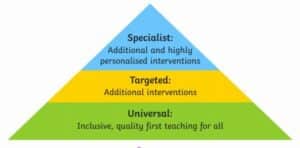
After Quality First Teaching, the next wave (Wave 2) is a set of actions or resources used alongside the quality first teaching provision and can be provided during lessons or in addition to them. To support the securing of an abstract concept through concrete object representation, additional adult support, writing frames, spelling banks or maths manipulatives may be used.
The next wave (Wave 3) adds further support beyond what has already been provided through Quality First Teaching and Wave 2. This may be specialised adult support, although this is expensive and hard to secure in school.
Tutors for children with SEN in Worcester
Wherever your child may be in their learning and whatever their learning needs are, connecting your child with a one-to-one tutor provides them with plenty of opportunities to succeed.
Learning away from the busy classroom environment, away from their peers and the social aspect of school also takes them away from any negative associations they have with the educational setting and their ability to succeed.
Limitless Learning one-to-one tutors provide a safe environment to learn with a one-to-one relationship for support. A place where the pupil has the adult’s full focus, and the learning is completely bespoke.
With Adaptive teaching approaches and an awareness of how to manage the cognitive load for each individual, our experienced tutors work with schools and families to create the best learning scenario for the learner.
We are here to make a difference and to show each child the amazing possibilities within them. We believe in them and are with them every step of the way as they break down their barriers to learning and see themselves succee
Author Bio: Natasha Willings
Limitless Learning Founder and Educator
Even before I had learned to teach, I have always had a great enthusiasm for working with children.
Over the years, through the support of amazing mentors, I have been able to gain clarity on how to generate engagement of children by hooking them into their learning and bringing each subject to life, by linking with their passions and learning styles.

I believe that every child has the capacity to be able to flourish with the right support. I have also researched profusely to create learning tools packs that could help close the gap for those with SEND needs, inside and outside of the classroom.
By tutoring on a one to one basis, my love for teaching grew as I was able to see how each hour of learning could have an enormous impact on the overall child’s development, educationally and psychologically.
These experiences have had a huge impact in shaping me into the teacher that I am today and have helped to develop the concept of my holistic, unique tutoring business which encourages children to embrace their creative flair and to learn through different concepts, such as gaming, to ensure the movement of learning from the short term to everlasting.

contact us
07554 994 174
limitless_learning@outlook.com